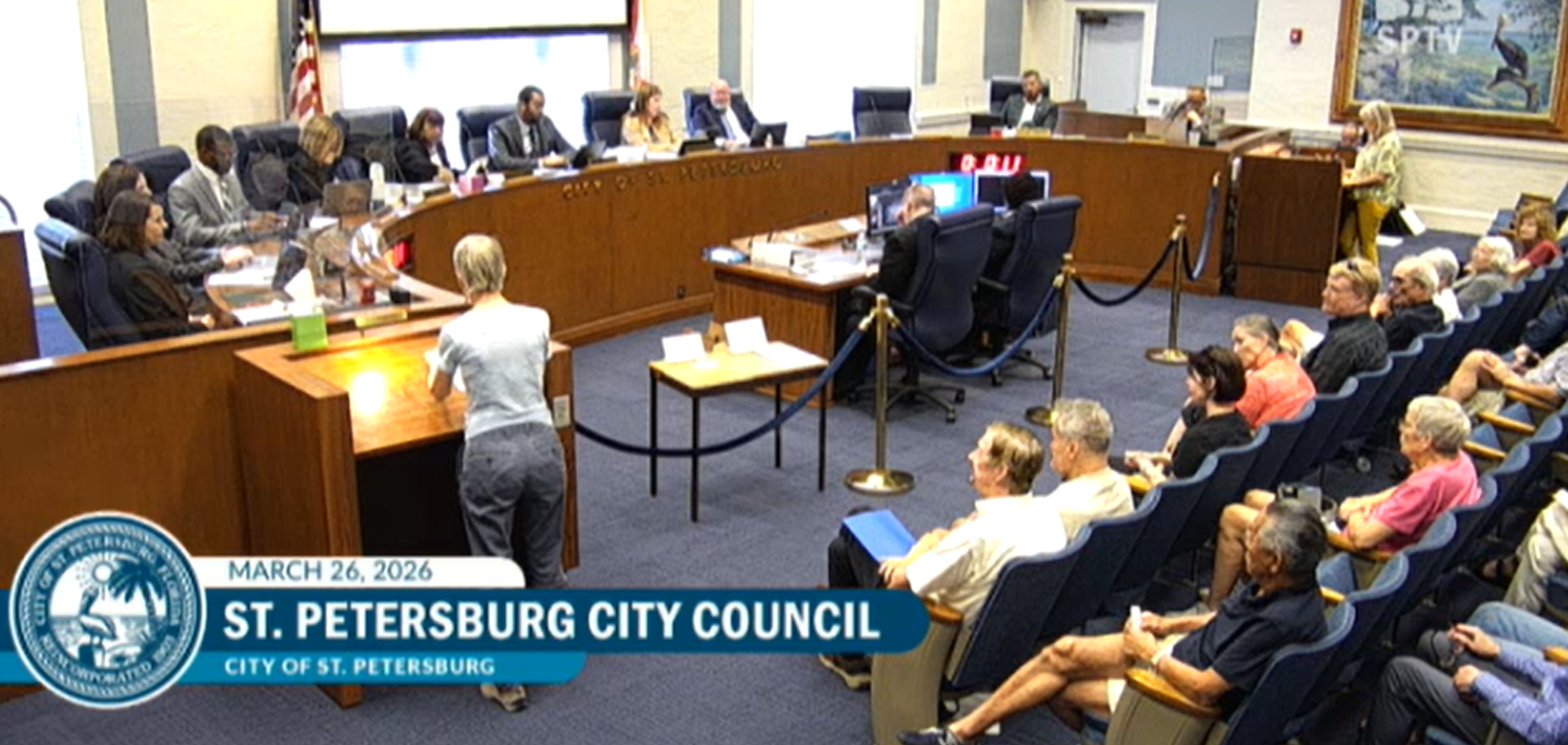
St. Petersburg's City Council and Community Planning and Preservation Commission convened on Sept. 24 for a joint “Committee of the Whole” meeting, an opportunity for both bodies, one elected the other appointed, to openly discuss preservation and planning issues.
The “COW” meeting took place in the auditorium of the President Barack Obama Main Library, designed in 1963 by noted mid-century St. Pete architect William B. Harvard, the same man behind the Williams Park bandshell and the former inverted pyramid pier. The setting was appropriate: a $16.8 million renovation finally reopened the library to the public last year, a reminder that St. Petersburg's historic buildings can, with a little investment, continue to serve the community.
Despite a packed agenda covering a range of historic preservation issues, the city's Intown Historic Preservation Grant Program prompted the most pointed discussion. Approved in 2018 with up to $5 million earmarked to help owners of historic properties in the downtown core with renovation costs, the city has completed only one grant cycle, awarding roughly $800,000 to several projects in 2019. Planning Director Derek Kilborn acknowledged the program was, in his words, "in the same place" as a year ago when the two bodies last discussed restarting it, citing a lack of staff capacity to move the program forward.
That lack of progress has been a recurring concern. Preserve the 'Burg has advocated since at least 2021 for additional preservation department staffing and a restart of the Intown grant program.
The city’s preservation staff must prioritize regulatory work such as certificates of appropriateness and the daily demands of preservation review, leaving the grant program and other priorities such as public outreach on the sidelines. Vice Chair Richie Floyd acknowledged the problem runs deeper than any single program, noting the planning department is already stretched with zoning overlays, transit-oriented development and other council priorities. He said increasing departmental resources should be a priority in future budget discussions.
Councilmember Gina Driscoll acknowledged the staffing constraints were real but said the result was equally real: property owners have gone years without another chance to apply for needed funding. "For it to have been held up since then, I think is a disservice to the city and also to those property owners who would like to do something," she said.
Funding for the grants also drew scrutiny. As the city revisits Intown CRA spending, the administration proposed reducing the program's total funding from $5 million to approximately $3 million. Councilmember Brandi Gabbard pushed back, arguing that with rehabilitation costs climbing, the city should be helping private owners absorb those expenses rather than reducing available resources. Preservation commissioners encouraged the City to fully fund the grant program and raised the idea of creating smaller grants to help historic homeowners outside the Intown district pay for roofs, windows, and siding, a category the current program doesn't fund.
One of the meeting’s more substantive proposals came from Commissioner Bob Jeffrey, speaking on behalf of the CPPC, who called for the city to develop a comprehensive historic preservation plan or a strategic document that would establish priorities and a framework for decision-making. The committee expressed support for forming a working group to develop such a plan, which could include Preserve the ‘Burg, developers, neighborhood representatives, city staff and elected representatives.
In written comments submitted prior to the meeting, PTB flagged two additional priorities: developing a deliberate preservation strategy for Central Avenue and expanding Transfer of Development Rights benefits to National Register-listed structures fronting the corridor. While neither issue was discussed, they represent tools the city could use to protect one of its most economically productive corridors as development pressure on Central continues to build.
Proposed amendments to the city's historic preservation ordinance introduced for discussion by Council Member Gabbard fell flat. The proposal included eliminating third-party designation applications, sunsetting the List of Potentially Eligible Properties, and raising the voting threshold for new historic districts from 50% plus one to above 60%, a nearly impossible threshold. PTB's letter, signed by Executive Director Manny Leto, described the package as the most significant rollback of the preservation program since its creation in 1985. Meanwhile, staff noted that adopting such proposals could result in the city losing its Certified Local Government status.
Referring to the proposed elimination of the Potentially Eligible List, Floyd took issue with a letter submitted by the St. Petersburg Chamber of Commerce, which referred to the list and other preservation programs as a hindrance. “That’s kind of the point,” he said. “It’s to make people stop and pause when working on a historic property [because] it could be an asset.”
You can watch the entire 2-hour meeting here. To hear Floyd's comments, skip to the 1 hour-26-minute mark.